
'Like Rats in a Cage?’ Or how (not) to have great ideas
Updated: Oct 5
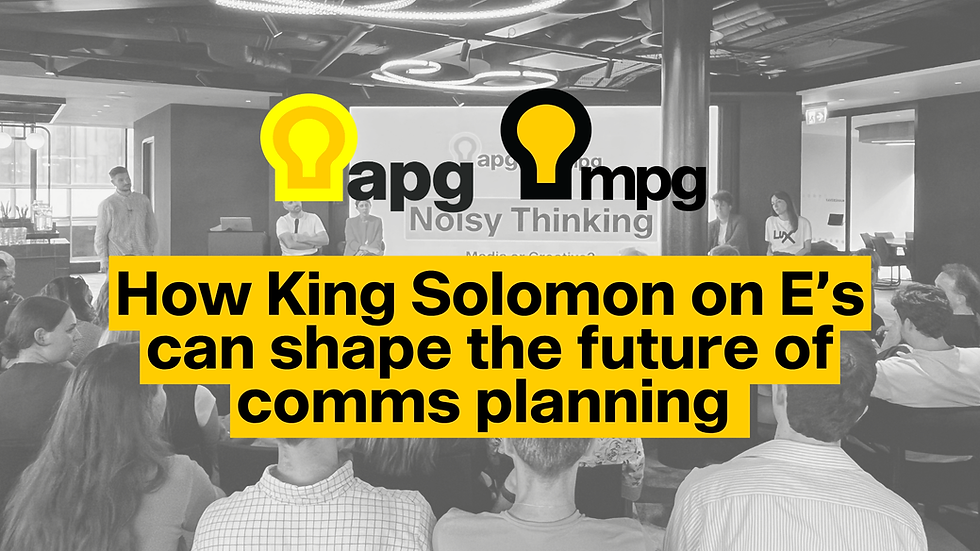
APG Noisy Thinking with Bruce Daisley
Put two rats in a cage for about 5 minutes. They’ve never met each other before. Or spent time in that cage.
Astonishingly, experiments have shown that the rats will exhibit 50 different ways of behaving in that short time; playing, exploring, testing their environment and so on.
But put a cat’s hair in the cage with them, and you kill all that stone dead. Their fear system is activated and it kills their ability to be ‘imaginative’ and engage.

Bruce Daisley was our speaker at APG Noisy Thinking. This was the first of many fascinating insights and anecdotes that explained for me, so electrically, how we can be so much more creative by leaning into our humanity. We know it’s miserable to be stressed and anxious and how those feelings militate against everything that is imaginative and expansive. And creative. The rats make the point so neatly. But how do we change? What do we do about it?
Bruce is a fantastic individual: Full of life and humour, obsessed with pop music, an expert in work culture, former European leader of Twitter in the good days, and brimming with ideas about humanity and creativity. What we can do and how we might change to have great ideas.
Bruce believes that creativity is a collective effort and it’s critical that we have fun together.
This is Tip 1.
The ur-tip, if you like.
And he exhibited this in real-time at Uncommon Creative Studio, who generously lent us their airy and beautiful space for this Noisy Thinking so we could go on this journey together as a strategy community.
He started with the idea of being in flow and how you achieve that. This is the state where
(Tip 2) you get your brain into ‘default mode’. Or day-dreaming. Or, (and I love this) ‘screensaver mode’. We only execute the default mode when we are not concentrating or have nothing to do. And that is the moment when we get our ideas.
Think back to when you have managed to silence your phone and sit staring out of the window; or when you were walking or swimming or gazing at the wall. You probably found it remarkably productive. Without even trying.
Aaron Sorkin claimed he got his best ideas in the shower. So he had 6-8 showers a day. Which is taking clean living to quite a degree.
James Webb Young wrote a book that is still quoted by strategists doing talks and running training for the APG. ‘A Technique for Producing Ideas’ is short and easy to read and it promulgates the advantages of the relaxed mode. If you need to come up with something great:
Do your research
Find links between things
Do nothing
Seductive, isn’t it?
What Bruce was able to demonstrate next, and this write-up cannot possibly do justice to, was how song writing can be a fabulous metaphor for the process of having great ideas.
So watch the video to get all the live juicy bits and enjoy Bruce’s energy and deep enthusiasm for his subject.
(And carry on reading for this strategist’s attempt to scrawl down the highlights and turn them into a few more tips for us all to ponder as we try and work out how we can have more, better ideas).
Bruce used clips of songs, and interviews with writers, and models of the Beatles collaboration (at its heart a dominant duo consisting of Lennon and McCartney) to make his case. He showed how over time the lone genius pop creator has slid into myth and been replaced by collaboration, and how an incredibly successful writer like Amy Allen with 7 amazing hits, admits she wrote 7 songs a week, every week for 7 years, to get those hits. She wrote a lot of flops along the way.
Tip 3: To have a good ideas, you might need to have 3,000 ideas along the way: The challenge is filtering and sorting them.
And Tip 4: it’s better to do it together.
So now we’re on to Tip 5 and it’s a big one. The salient thing that I took out was the absolutely critical need for psychological safety. Psychological safety comes from feeling you are part of something, and feeling confident that you can say something silly or have a bad idea, or challenge authority and know that you will be OK. You feel confident in the work that goes on. Your team is high functioning and - weird one this - the ‘best’ teams apparently make twice as many mistakes as others. But look closer and you discover that the best teams were just admitting to making those mistakes. They felt safe enough to be transparent.
People need to feel that they are connected to those around them. It’s what Bruce calls a sense of ‘we-ness’. Think back to your happiest and most productive times at work and you will probably find that’s how you felt - or feel. It’s also when you probably did your best and most creative thinking and inspired that in others.
Part of this is ’Mattering’, the feeling or belief that you are significant to other people and that they respect you. This is a very important part of building a team, that people feel plugged into a collective.
There are some wonderful examples here of ‘predictors of engagement’ - the things that make us feel we matter. And they are seriously surprising. I would not have thought that having a friend at work is the most powerful predictor of engagement:
Having a good friend at work that you trust: 7x
Valuable performance feedback: 5x
Recognition: 4x
Role clarity: 2.5x
It’s a mix isn’t it? Tip 6: Of the things that go on score sheets and feel a bit HR it’s the things that are about being a happy human being that are most important. Like having a pal who’s got your back.
It’s also about behaviour in a group. Bruce ran a real-time experiment in reading emotions through the expression in someone’s eyes. Look it up. It’s a Professor Sir Simon Baron-Cohen experiment to establish autism. As you probably know, the capacity to read another’s feelings is a good predictor of ability to collaborate, and collaboration works when there is a collective intelligence in the group that recognises this. You build this collaborative effort when the team members feel understood and seen. It’s not rocket science is it? And although it’s not always easy to effect, remember Tip 7: All of us are better than any of us.
Back to the room. Everyone was frantically making notes on their phone so it was a relief to get to the Q&A and look up for a bit.
Bruce was joined by David Wilding who led the questions. They used to work together at Twitter and were a living example of happy collaboration in action. The questions were great and yielded 2 more tips.
Tip 8: ‘Maker’s’ time vs manager’s time. This was fascinating, and really important if you want to get the best out of your creatives. Drop a meeting in the middle of a maker’s time, and you destroy their flow. If your job is to come up with and play with ideas, the things like Teams and Slack, if used unchecked, wreck their time for coming up with the very ideas that we’re here to celebrate.
Bruce described a process of coming up with ideas where there is ‘easy time’ at the start. You’re just getting stuff down and doodling around. Or you’re sitting without interruption and writing for an hour. It’s only once you have got to this stage that you are in a state of deep flow. The very thing that helps inspire good ideas. If you interrupt that, you’re done.
Tip 9: Yes! Strategists really could do with having a partner too. Someone you have a strong and candid connection with, with whom you are aligned, and you bounce off ideas and feel safe.
You can guess the question.
Looking back on the ideas of the evening I felt once again that the consistent theme underlying all our efforts to be high functioning creative strategists is the importance of leaning into what makes us happy and fulfilled as human beings. It’s fundamental in all the debates about AI. And about research and how we work. We know that to do a good job we need to involve real people and real life in our output and get away from the screens. The more we bring humour and the messiness of life into what we think and create, the more profoundly we connect with our audiences.
This applies just as much to how we work. And we need to do that together.
9 Tips.
And our community has the last laugh.
Sarah Newman
APG Director


Comments