
How King Solomon on E’s can shape the future of comms planning

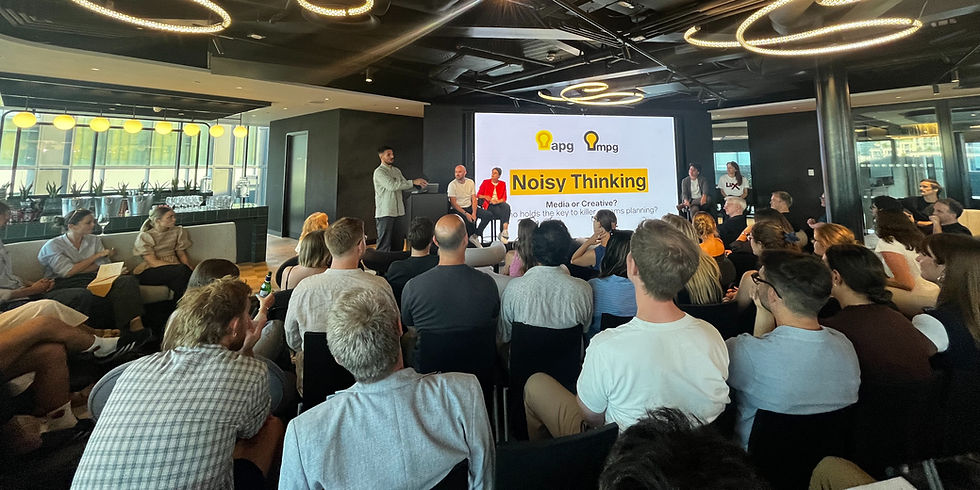
Tuesday’s Noisy Thinking debate started with a provocative but pretty straight question:
'Media or creative? Who holds the key to killer comms planning?’
It was the first APG/MPG joint event and it was essentially about collaboration: How to develop a common and workable understanding of what good comms planning is, how we can work better together and what ideas and practices would foster that collaboration and bring about better outcomes for our brands and clients.
Will Grundy, CSO of adam&eveTBWA was a perfect host and guide through the event. And even if he hadn’t offered the stunning roof terrace at their new office, complete with Old Bailey and St Paul’s domes for neighbours, a perfect summer evening and ample cold beers, it was a brilliant evening of noisy thinking that will help to reset the agenda. And bring us all closer together.
Comms Planning is one of those notions that eludes quick definition.
And that’s fine. We’re in a complex world that thrives on novelty and new thinking, and an element of healthy dispute is part of the way we work. But we do need to get to a better understanding and agreement about what we are trying to do.
At Noisy Thinking, taking in King Solomon and some wildly helpful narcotic metaphors, I think we did just that.
What follows is a brief account of the main points made in just 5 minutes by each of the speakers.
Lola Neves is Head of Planning at Uncommon. Paying homage to adam&eveTBWA, and the pioneering work of Binet and Field, she claimed fame as the killer strategy that should focus all our efforts. In a world where people pay not to watch the ads, most don't care about brands, and much of our work is not even noticed, it’s comms planning that demarcates average from great work: The ability to put an idea out that drives more valuable impressions.

Start early
The problem is that we are not very good at comms planning. We shouldn't confuse it with media planning. Comms planning is based on collaboration and collaboration is not a KPI. So we need to work harder at it. We start the comms planning process far too late and we have insufficient appreciation for our different skill sets.
Love each other and collaborate
Creative strategists can’t do it without the media planners but they need to double down on their role in caring massively about the strategy and the idea, taking lateral leaps and fostering the imagination.
Add more meaning
At Uncommon, they use a simple question to guide their comms planning: How can I make this idea more meaningful to my audience? Where, when and in what place and what context can I achieve that? Take the answers to those questions and build an ecosystem around them.
Greg Newman is a Strategic Consultant at Craft Media, and he has a fine line in powerful visual metaphors to land his points. (see the pic at the head of this piece).
He was full of pithy advice about what we're doing wrong and how to do it better.
You have to understand the role of entertainment in real peoples’ lives and reach into that.
He flashed up a visual from the ‘Best film of all time’. I hadn’t heard of it.
No-one in the audience had heard of it.
I can’t even remember what it was called. What I do remember is that Greg said it was 3 hours long and 1,000 critics had voted for it. In the real world, nobody has ever seen it.
When form leads function we’re doomed
According to Greg, the ‘5 best campaigns’ of last year all led with 2-minute films. This is not a paid format, so they are not even adverts. This kind of work does not exist in the real world.
When comms planning is dictated by a media planning process, you are doomed again
You can end up with a plan with 1 partnership deal and a price tag of £1million.
Enter the 4 Es
Having set up the problem with creative panache Greg reached for his narcotics. And a prescription to help us work out how to do it better and grapple with the knotty conundrum of who leads?
E1 Effectiveness. Work to business outcomes. How is this plan better at delivering the objective?
E2. Empathy for the audience - who really understands them?
E3. Effort. Really caring about the idea and the outcome is an effectiveness multiplier. Greg echoed Lola in reinforcing how important it is to really care about what you’re doing and why. Hard work makes the difference between a good and bad campaign.
These 3 Es are up for grabs. Although structurally media agencies are set up to do it, they tend to abdicate responsibility.
E4. Expensive. You need time and expertise and people to do it properly. The way forward is to be focused on delivery, not process. (And handily, Craft Media exists because of that gap)
Sabina Usher is Executive Communications Strategist & Partner at Ace of Hearts and personally embodies both media and creative approaches having moved from a media to a ‘creative’ agency.

Comms planning is a Frankenstein, ill-defined and provoking wildly different answers across a room. And this is a problem because it’s easy to make an ill-defined discipline smaller when we need to recognise that comms planning is actually responsible for the whole life of an idea.
It’s about life and caring
What happens when both disciplines want to be in charge of the comms planning process? Sabina harnessed a Biblical example as her metaphor. She related the tale of King Solomon who, confronted by two mothers claiming a baby was theirs, threatened the life of the baby to determine who the real mother was.
You’ll remember the outcome - one of the women would rather lose her child than see it destroyed.
A world where we can reach everyone but they don’t care is a problem. And ideas without comms planning are just executions.
(And that’s a tone-setting anecdote, if ever I heard one)
We need to organise differently
Commercial incentives limit our imagination and collaboration is not enough if the organising principle is wrong. The world does not respect our organisational boundaries and the problem we face now is abundance:
Reach is not scarce, exceptions are not scarce; coherence is scarce.
We are asking the wrong question:
Comms planning is editing
Why are disciplines the organising principle? Comms planning is much more like the role and tasks of an editor, editing the life of the idea and it has to be built into the idea.
The future belongs to the people who keep the idea alive
If ownership is the wrong question, life is the right one.
And the challenge is to put the life of the idea ahead of our claim to it.
Fran Blair is Integration and Enablement Lead, EMEA at WPP Media. Fittingly, she started her career in media and now works in integration. Fittingly, she also reached for a team-working, and more refined metaphor to make her case.
Playing doubles tennis is about playing together, acknowledging strengths and weaknesses in your partner to win.
The goal is to successfully influence consumer behaviour.
The best ideas are built together with people brining different skills and approaches - creative (culture and feeling), media (thinking across platforms) and client (business problem). If the goal is making the best experience for the customer, the work gets so much better.
You need to align on the strategy (opportunity, insight and big idea) and allow media to shape ideas so that they are a vehicle for consumer experience. As media planners have the data and understand the customer, capturing good media thinking makes the campaign better.

It needs to be done at the planning stage: 'This Girl Can'
Fran reached for an example in her own experience that happened to be an APG Grand Prix winner. The whole campaign was built around the universal insight that women fear judgement. It lived across the whole comms plan and even reached into the parts that many insights don’t reach - in this case Spotify sending reminders to women who’d stopped listening to their gym playlists to get back in the gym. Using the positivity of their music to inspire them.
You do need to adapt the creative to work effectively across different channels.
A comms plan should be inseparable from the idea.
And this was encapsulated brilliantly by Sabina in the subsequent and healthily pointy Q&A. An excellent way of assessing the power of a comms plan. I leave you with her killer question:
What is the smallest expression of this idea? Is that going to be effective?
Since writing this post, we've had a lot of feedback about the evening. Lots of it. And it's among the most enthusiastic commentary on an APG event this year. I put this down to the collaboration between the media and creative strategy worlds: Our willingness to find common ground and better ways of working without brushing differences and points of contention under the carpet.
Above all, we were left with a powerful sense that we can do this most elusive, fascinating and deeply important aspect of our work better. And at the risk of going all political slogan on you: Better Together!
If you’ve found this account of the evening at all interesting or useful, and if it’s inspired in you any thoughts about what we at the APG and MPG could do to bring some of these ideas to life, or to help train and shape the community experience of comms planning, do get in touch with me directly sarahnewman@apg.org.uk and we’ll do what we can.
We will be re-running the excellent foundational MPG training course on media planning fundamentals this autumn. If you'd like to take part, email molly@apg.org.uk.
And if you like this stuff, it’s so much better if you’re there in person. It was a really sociable and friendly event and brought to life the collaboration across the APG and MPG. Thank you to everyone who came along, and you for reading.
Take out a membership of either APG or MPG. The overall benefits are common to both, and we have specific activities tailored to both media and ‘creative’ planners.
Sarah Newman
APG Director


Comments