
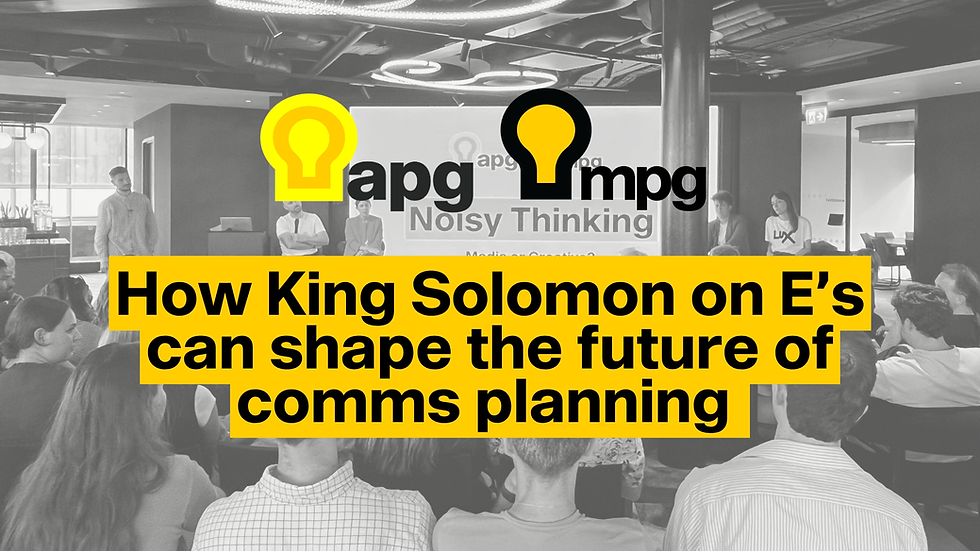
The Noisiest Moments of 2026: APG Noisy Thinking November 2026
Highlights of the Highlights
Last January was rather bleak. People were a bit depressed about the prospects for the year, so APG Noisy Thinking zagged and went all cheerful. It was a blast.
And as we crawl towards the end of another somewhat bumpy year for the industry, the APG still sees lots of reasons to remain relentlessly Pollyanna about creative strategy.
So we asked 8 delicious strategists, representing different ‘flavours’ of strategy, to nominate their personal strategy highlights of the year. And tell us why they were so noisily effective.

The brief was: You’ve got 3 minutes to convince us, and you can take your example from anywhere. It doesn’t have to be marketing. And it can’t be your own work.
Six out of the eight speakers went straight to culture, politics and celebrity rather than brands/marketing.
If I asked you to imagine an event by, with and for strategists I’m not sure that ‘stand-up’ would be the first thing that sprung to mind.
Maybe ‘cerebral’ or ‘mildly anguished’ or any of the other so-last-century ideas about strategists that still float about in the ether. And if so I’d be the Last One Laughing (I’m so 2026) as it was genuinely hilarious, energetic and original.
And with so much to apply to what we do every day. So here are the highlights of the highlights and I hope they are useful.
Let’s start with politics: US and UK.
Authentic comms strategy: Brand Burnham
Jo Arden, CSO of AMV BBDO picked Brand Burnham as a brilliant example of comms strategy. And I agree. Ever since the election Andy has been popping up on my feeds in a way no politician has before - and I’m a politics nerd. And I’m not bored of him yet. For me the clip of him doing a Wordle on College Green in real time back in the summer was a perfect bit of precise targeting. (Not being a pint in the pub and Pork Scratchings kinda gal). Clever.
So how’s it done?
Jo showed how personality is a strategic asset when it remains genuine rather than becoming a constructed persona. Andy Burnham has defined himself by being a human first and the prime minister second. She was awash with examples: Early on he hit back at Kemi Badenoch with eyelashes to camera and a BLUE T shirt after she accused the Labour party of abandoning Starmer for a pair of eyelashes and a black T-shirt.
He was seen at the Manchester memorial, supporting Everton with his Dad who had Alzheimer's, and having inconsequential, silly conversations with his mate, the Mayor of Liverpool.

Jo reiterated that Communications should fit the platform and audience and how you can package broad policy ideas through tangible examples. For example, Burnham talking about bus fares when obviously, what he was really talking about is a global economy and cost of living crisis. It’s a clever way of demonstrating tangible progress.
Ever since July, he has maintained his 6am reach-out on socials, by-passing the Westminster journos and speaking directly to ‘the people’ who have to get up and go to work. And he has managed to maintain noticeability and also relevance across a huge number of different audiences on his platform.

As the PM, he has had to create a new way of showing up, which is him as a serious politician on the global stage. But he's done that by embracing his personality and letting that be the leverage of how successful he is.
And so far it works. He is still the most favoured of all the party leaders.
(And let’s see how the recent furore of asking Influencers in number 10 plays out)

And the lesson for brands is: Find a personality. Don’t become a persona.
(if you’ve seen ‘You can see everything’ by Nathan Fiedler, and I won’t do any spoilers; you might find this ‘persona’ point very pointy.)
Deviant Strategy: Sabotage
Max Keane, CSO of VCCP Blue, always comes across to me as a nice bloke with a benign manner and a GSOH. Delightfully, he went all aberrant about the Democrats’ somewhat scurrilous mid-terms win in Alaska.
He was basically saying that sometimes you are using strategy in a zero-sum contest and that’s where being devious can win you the edge. Alaska had voted Republican for 50 years bar one aberration. In 2026, the Democrats pored over the electoral roll to find a citizen with the same name as the Republican candidate Dan Sullivan. Enter Dan Sullivan from a sleepy Alaskan fishing village to stand as a Dem and try to wrest votes from the Republican rival. It worked. The Democratic candidate won by the tiniest of margins strategy in a zero-sum contest.

As Max says: ‘We planners are lovely people, APG is nice. We should always be nice, but maybe being naughty sometimes is a good thing to do’.
And now we’ll segue straight to celebrity, barely pausing to take a shamefaced breath.
Badass Bitch Strategy: Madonna
CSO Kat Arnull, of Golin Ketchum, and PR strategist par excellence, chose Queen Madge and divined some brilliant lessons for inserting yourself right into the middle of contemporary cultural conversation and making a mint in the process:
Madonna’s approach is basically disruption, community, cultural codes, live events, collaborations, and commerce.
She brilliantly uses partnerships and fan-focused references to extend cultural relevance and shareability.
She took to the stage at Coachella, screaming at the crowd to get rid of their phones; knowing where the influencers are at and where culture happens.

She developed social partnerships with Grindr and Charli XCX and got together with Kylie to please the gay audience.
She’s commercially electric and now has more Number 1s than Elvis.
Message, Medium, and Moment. The take-down of Brand Beckham
Matt Waksman, Head of Strategy at Droga5 chose Brooklyn Beckham's takedown of Brand Beckham as the most perfectly calibrated strategy in terms of media, message and moment.
These three themes stay consistent for every flavour of strategy.
The core of this message is brilliant because, like all great strategies, it must position and deposition. So the position Brooklyn takes is: ‘I am a victim of the PR-controlled narrative of Brand Beckham.’ That doesn't just give him a position; it means that Brand Beckham can't respond because they will respond through the perfect PR narrative. So they are immediately snookered. They're gagged, and not in a good way.

What about the medium? Let's look at the basics. It's just 843 white words on a black background. Now that's perfect because it means that it's made for reactions, analysis, Reddit, Substack, reaction videos, but more than that, he buried the perfect Easter egg: the accusation of the ‘oedipal twerking’ moment of his mother at the wedding.

This would ignite every TikTok and internet sphere out there and they weren’t able to find the footage because he put stickers on top of everyone's phones at his own wedding. The fire is lit.
But of course the piece de resistance was the moment.

It came out in January when everyone hates their families - and we saw the most perfect, famous family fall apart. But it was down to the strategy, not just his fame. Before this explosive moment on 19th January, he was losing 5,000 followers a day. After he posted, 30 days later, there was an increase of 1 million followers.
And as Matt puts it so beautifully, we're left with that old question: Was it down to the strategy or was it down to the creative? Is he a strategist or is he a creator?
The ultimate proof that he's a strategist is that when he does engage his creativity, it's not half as good.
But it wouldn’t be a strategy event if we didn’t hone in on people, culture and the looming of AI.
Advocacy - Paternity Leave
John deGraft-Johnson is Head of Strategy at Ark Agency. As a new father, John found the scales falling from his eyes when he went on paternity leave:

The need for a complete re-frame of paternity leave as support for mothers, and the subsequent agreement by Andy Burnham that he would subvent a change in policy.

It was the passion and advocacy of campaigner Anna Whitehouse on TV one morning that changed his heart: ‘At two weeks, men or non-birthing partners walk out the door back to your work as your breasts are leaking, your tears are falling, your hormones are raging, your scars are burning, and your baby is crying. That is the junction when the UK thinks it is acceptable for our partners to walk out the door’. Her testimony, working with groups of mums and dads and compelling Bridget Phillipson to meet her, led to a new paid-leave policy for self-employed fathers affecting 70,000 families annually.

People in an AI Era
Ruairi Curran is CSO of Gravity Road. He is an AI expert in our strategy world and he teaches, humanely and brilliantly, on APG courses.
All the more powerful than that, his noisy moments are about humanity winning out in the age of AI, as AI is
so easily replicable and impersonal.

Ruairi figures that so-called AI ‘slop’ remains - a phrase that could apply to so much of the output of strategy, strategy paperwork, briefs, decks and frameworks - are just being thrown around all over our thinking. So this frames his point of view on what was attractive and admirable in 2026:
People.
It’s examples like this, driven by amazing and influential people, that have the most profound effect and make the most noise.
Mark Carney, Canadian leader, emerged from being bank manager in charge of the UK to headline-grabbing world leader as he battled Trump with exceptional bravery.
Hannah Spencer, plumber, and more ‘normal’ or ‘ordinary’ than you can imagine, was elected MP in the recent Gorton and Denton by-election.

The Burger King CEO who could eat a burger like he actually eats and likes them, and gave out his phone number to the world. And Andy Burnham… All of these apparently authentic public figures cement the appeal of personal, credible communication.
Employee Advocacy
Rachel Porter is Head of Influence Strategy for Ogilvy, EMEA
For Rachel, the noisiest trend of the year is employee advocacy, an approach that has been tried for years with limited success but has really taken off for the first time.
Her first example was advocacy done terribly: the CEO of McDonald's filming himself trying a new burger in a very sterile office environment and taking out the teeniest, tiniest bite, referring to the bite as a ‘big boy bite’, and then referencing the burger as their ‘new product.’ Ouch. Rachel suggested, politely, that this ‘didn't quite resonate with the consumer’. Burger King saw that and went in for the kill, as we saw earlier.

By comparison Staples - a US stationery chain - supported and amplified their employee Kaeden’s (‘Staples Baddie’) organic social content rather than shut it down and created a huge level of positive brand sentiment.

And M&S amplified product-development leader Kathryn Turner’s behind-the-scenes content.

Influence is very hard to measure but coincidentally (or not?) M&S’s share price rose nicely over the same period…

Battling Conviction, Desirable Numbers and the Bayeux Tapestry

Emily Fairhead-Keen is a media strategist by training and now a Senior Strategist at Lego.
93 penises, 623 men, 190 horses, and 3 women. This was a massive cultural event supported by brilliant strategy, using narrative archetypes, audiences with strong interests, and memorable figures to build attention and ticket demand.
How did they do it? Think quest.
And rethink the Comms Plan to be an evolving anthology of story archetypes and genres which keep audiences hooked:
The dogged determination to get the agreement to host it over the line. (Testament to Keir Starmer, according to Emily, who was clearly getting a bit fed up about all the Burnham burnishing that was going on).
Segmenting the audiences into vertical passion pools - people who actually cared; people with passion, using every single channel from adverts to gift shop merch to the people who really gave a shit about this thing, from the needleworking knitters, the historians and mathematicians, the designers and artists. And they did a whole program of communication for, arguably the world's most curious people: children.
Using numbers that not only had social currency and were funny, but numbers which were quoted to drive desire: The numbers in the online queue fixed indelibly in their minds as people raced to get tickets.
And the result? It was a frenzy for tickets, which outsold Tom Holland's Spider-Man in a single morning, and a win to convert stubborn young masses. 55% were under the age of 25.
And one in the eye for the French 🙂

(Couldn’t resist that one. Sorry, Emily)
So all in all, one of those evenings that delivered precisely on the Noisy Thinking brief: Give people reasons to feel stimulated and inspired, and something useful to take away and apply to the day job. And remind them what a great job creative strategy can be.
Sarah Newman
25th November 2026


Comments